


Furnace Leaking Water? Why It Happens in High-Efficiency Units
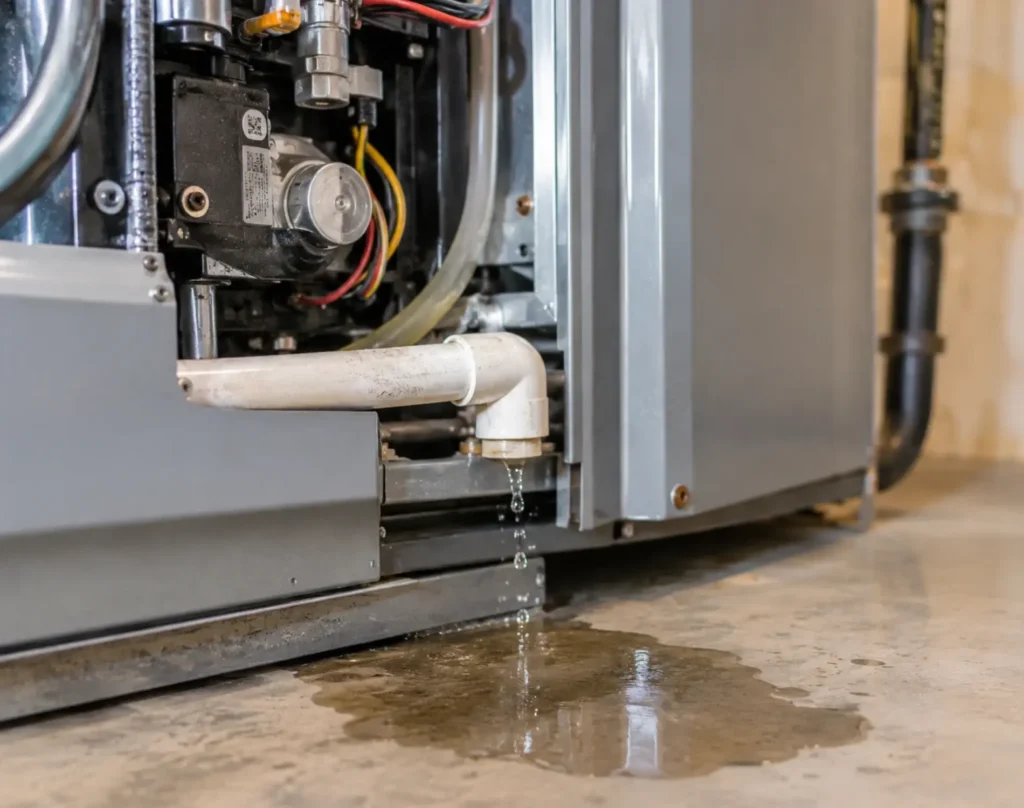
If you notice water on the floor near your furnace, you’ll wipe it up. But if a few hours later, the puddle is back, it can be frustrating or alarming.
You start wondering: “Where is this water coming from? And why would a furnace, which is supposed to produce heat, be leaking water?”
If you have a high-efficiency furnace, the water may be coming from the heating process itself. These furnaces produce condensation, which normally flows away through a drain. When that drainage system has a problem, water can end up on your floor.
This guide explains what could be causing the leak and how to tell whether it needs a repair.
Why Does a High-Efficiency Furnace Produce Water?
Most older gas furnaces send hot exhaust gases outside through a metal vent. High-efficiency models work differently. They take more heat from those gases before releasing them.
To do that, they have a second heat exchanger. As the exhaust cools, some of the water vapor inside it turns into liquid. This is called condensation.
The water collects inside the furnace and passes through a drain line. Some homes have a small pump to move it to a drain.
So, the furnace producing water isn't the problem. The problem is finding that water somewhere it shouldn't be.
Here's a quick comparison to help you understand how a high-efficiency furnace differs from a conventional model:
| High-Efficiency Furnace | Conventional Furnace |
| Usually rated 90% AFUE or higher | Commonly rated around 80% AFUE |
| Has a second heat exchanger | Usually has one heat exchanger |
| Produces condensation during heating | Doesn't normally produce condensation inside the furnace |
| Needs a condensate drain | Generally doesn't need one |
If you're unsure which type of furnace you have, look at your furnace's model information. High-efficiency furnaces also commonly have plastic exhaust pipes.
Why Is Your High-Efficiency Furnace Leaking Water?
Water can escape from several places, but technicians often start by checking the drain line, pump, and connections. Here are some common reasons behind your furnace leaking water:
1. The Condensate Drain Is Clogged
Every time your high-efficiency furnace runs, the condensation needs somewhere to go.
Over time, dirt and buildup can collect inside the drain line. Water then drains more slowly or stops flowing altogether.
Once it backs up, you may see water dripping near the tubing or pooling underneath the furnace.
Some models have a safety switch that stops the furnace when the drainage system backs up. So, if your heat suddenly stops working and you notice water nearby, the two problems may be connected.
A technician can clear the blockage and check whether the drain is working as it should.
2. The Condensate Pump Isn't Working
Take a look beside your furnace. Is there a small plastic tank with tubing attached?
That may be your condensate pump, which is not always required. It's usually installed when water can't flow directly into a drain.
When the pump works, it collects condensation and sends it away. But if the motor stops or the float gets stuck, water can build up inside the tank and eventually overflow.
Sometimes the pump itself is fine, but the tubing carrying water away is blocked.
If you notice water around the pump, check whether it has power. Leave any electrical testing or repairs to a professional.
3. A Drain Tube Has Come Loose or Cracked
A loose connection can cause a surprising amount of water to collect on the floor.
The tubing may have slipped out of place, developed a crack, or been damaged by something stored against the furnace.
The heating may work perfectly well, but the floor gets wet whenever the system runs.
Look for dripping around the visible connections, but don't pull the tubing apart to investigate, though. A small leak can become a bigger mess if the connection is disturbed.
4. The Condensate Trap Is Blocked
There's another part of the drainage system that homeowners don't always know about: the condensate trap.
It helps water leave the furnace while preventing combustion gases from escaping through the drain.
Dirt and buildup can clog the trap, causing water to collect where it shouldn't.
This isn't a part you should remove and clean without knowing the furnace's requirements. If it isn't put back correctly, the system may not operate safely.
An HVAC technician can clean the trap and check the rest of the drainage system at the same time.
5. Water Is Collecting in the Exhaust Vent
High-efficiency furnaces usually have plastic exhaust pipes.
These pipes need to be installed at the correct slope so condensation drains in the intended direction.
If a pipe is blocked, poorly positioned, or leaking at a connection, water may collect and escape near the furnace.
You might also notice that the heating system shuts off unexpectedly.
Because the vent carries combustion gases, don't try to disconnect or reposition it yourself. Have the venting checked by a qualified technician.
6. Something Inside the Furnace Is Damaged
What if you can't find any water around the drain tubing or pump?
The leak could be coming from inside the furnace cabinet.
A damaged condensate collector, internal connection, or secondary heat exchanger may be responsible.
These problems are harder to identify because the affected parts are often hidden behind panels.
A damaged heat exchanger can also raise safety concerns, so it's important to find out exactly what's leaking before using the furnace again.
What Should You Do When You Find Water Around Your Furnace?
You don't need to disassemble the furnace to get a better idea of what's happening.
Start with these simple checks.
1. Turn off the Heat
Switch the thermostat to OFF. If water is near wiring or electrical parts, keep it clear of the equipment. Only turn off electrical power if you can do so safely from a dry location.
2. See Where the Water Is Collecting
Is it directly below the furnace? Around a drain tube? Or beside the condensate pump?
You don't need to find the exact cause. Just noticing where the water appears can help when you call for service.
3. Check Whether Another Appliance Nearby Is Leaking
Water around the furnace doesn't mean the furnace is leaking. A water heater, humidifier, or plumbing pipe near the furnace could also be responsible for leakage. In some homes, the air conditioner also shares drainage components with the heating system.
4. Clean Up the Water If it's Safe
Use towels to soak up standing water and move anything that could be damaged. Avoid opening the furnace cabinet or touching wet electrical components.
If you can't tell where the leak is coming from, leave the furnace off until it has been inspected.
When Is a Furnace Water Leak Serious?
A small puddle doesn't always mean a small problem. Here's a quick way to understand what you're seeing.
| What You Notice | What It Could Mean |
| Water dripping from visible tubing | Loose connection or clogged drain |
| Water overflowing from a small pump | Pump failure or blocked discharge line |
| Furnace stops heating and water appears | Drainage safety switch or another system fault |
| Water coming from inside the cabinet | Internal drainage or component problem |
| Water touching electrical parts | Potential electrical danger |
If water is entering the furnace cabinet or reaching electrical components, don't restart the system. Arrange professional service.
If you smell gas, leave the building and call your gas utility or emergency services from outside. Leave immediately if a carbon monoxide alarm sounds.
How Can You Keep Your Furnace From Leaking Again?
You can't prevent a high-efficiency furnace from making condensation. That's simply part of how it works.
What you can do is make sure the water has a clear path out of the system.
- During annual furnace maintenance, ask the technician to check the drain line, condensate trap, pump, and exhaust vent.
- Between visits, take an occasional look around the furnace.
- If you notice damp flooring or water marks, don't assume they're harmless just because the heat still works.
- Also, avoid stacking boxes or other belongings against the drain tubing. A tube that's been pushed out of place can start leaking.
Frequently Asked Questions
My furnace is new. Why is it already leaking water?
A new furnace shouldn't leak onto the floor, even though it produces condensation.
Sometimes the issue comes from improper installation. A drain line may have the wrong slope, a connection may be loose, or the condensate pump may not be working correctly.
Contact the installing contractor and ask them to inspect the drainage and venting. If the furnace is under warranty, check what repairs are covered before paying for service.
Why does my furnace leak water during freezing weather?
Cold weather can cause condensate lines to freeze, especially when they run through unheated spaces or drain outdoors.
Once ice blocks the line, water may back up toward the furnace. This is more likely during long periods of freezing temperatures.
A heating professional can check whether the drain is properly routed and protected from freezing. Don't use boiling water or an open flame to thaw the pipe.
Does water leaking from my furnace mean I need a new one?
Not necessarily. Many furnace water leaks can be fixed by clearing a drain, repairing a connection, or replacing a failed pump.
Replacement becomes a consideration when a major internal component has failed, or the furnace has extensive corrosion.
An experienced HVAC technician can explain the repair options, check the condition of the equipment, and help you decide whether fixing the furnace makes financial sense.
Takeaway
A furnace that keeps leaking water isn't something to put off until the heating stops working.
What looks like a minor puddle today could point to a problem that gets worse with continued use.
If you've cleaned up the water more than once, it's worth having a professional take a look. An inspection can help identify what's going wrong and whether a repair is needed, so you're not left dealing with a bigger problem later.
Furnace Leaking Water in Sacramento? Call Ace Plumbing, Heating, & Air Conditioning
You shouldn't have to figure out a furnace leaking water on your own. Whether the problem involves a condensate drain, pump, humidifier, or another heating component, Ace Plumbing, Heating & Air Conditioning can help find the cause.
We've served Sacramento homeowners since 1972. As a family-owned company with an A+ BBB rating, we have more than 54 years of experience handling heating problems.
Our skilled and licensed technicians (#313506) provide:
- Furnace repair in Sacramento
- Heating system maintenance
- Furnace installation
- Heat pump services
Don't let a small furnace leak turn into a bigger repair. Contact Ace Plumbing Heating & Air Conditioning at (916) 455-4548.